
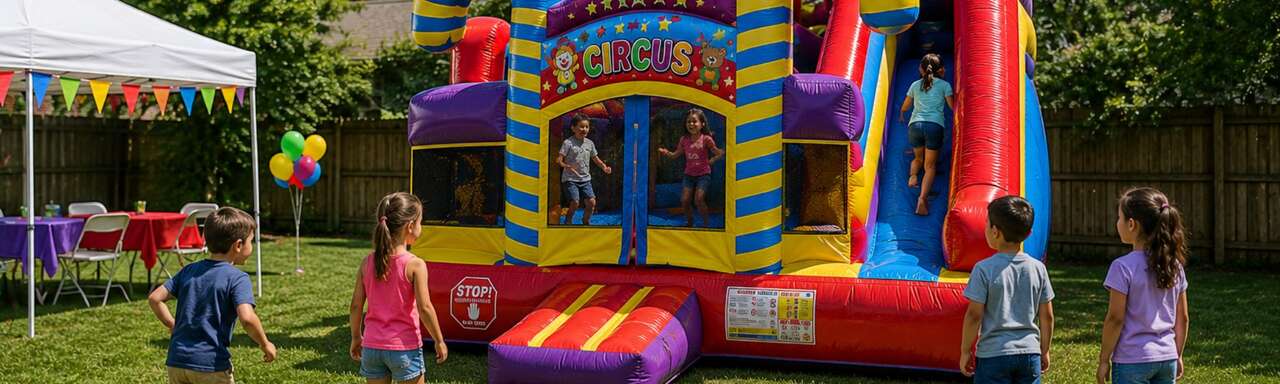
Choosing the Right Bounce House for Mixed-Age Kids (Without the Chaos)
You're planning a party with a three-year-old, a seven-year-old, and a couple of tweens. You want one inflatable that keeps everyone happy and safe—not a bounce house that turns into a collision zone five minutes in.
The wrong setup means you're pulling toddlers out of danger, refereeing older kids, and wishing you'd rented two units. The right setup? Kids self-sort by activity, everyone stays engaged, and you actually enjoy the party.
Here's how to choose a bounce house for mixed ages that works for toddlers, grade-schoolers, and tweens without turning your backyard into a liability.
What's In This Guide
Which Party Are You Planning?
🎈 Sibling Birthday Party
You're celebrating two or three kids at once. Ages 3–10. You need one unit that doesn't favor the older kids or bore the younger ones.
Your best bet: Deluxe combo with slide. Toddlers bounce, older kids race on the slide. Natural separation.
🏫 Neighborhood Block Party
15–30 kids, ages 2–12. You have no control over who shows up or when. You need a unit that handles chaos and keeps little ones safe from big kids.
Your best bet: Dual-unit setup or one large combo with obstacle zones. More space = fewer collisions.
🎉 Family Reunion
All-day event. Kids ages 1–14. Some parents supervising, others not. You need a setup that works all day with rotating age groups.
Your best bet: Large wet/dry combo + dedicated toddler zone. Time-slot rotations by age. Adult spotter assigned.
Why Most Bounce Houses Fail With Mixed Ages
A standard 13x13 bounce house is designed for one age group. Same size kids. Same energy level. Same risk tolerance.
When you add a 40-pound three-year-old and a 90-pound ten-year-old into the same bounce chamber, physics takes over. The bigger kid launches. The toddler goes airborne. Someone cries. Party paused.
⚠️ The Weight Differential Problem: Industry safety guidelines recommend keeping weight differences under 50 pounds in shared bounce zones. A 30-pound toddler and an 80-pound second-grader should never be in the same open bounce area at the same time.
What fails: Single-chamber bounce houses, castle-style units with no activity zones, undersized inflatables where kids are forced into contact.
What works: Multi-zone units where kids self-separate by activity preference, not forced interaction.
Unit Types That Actually Work for Mixed Ages
Deluxe Combo Units
BEST FOR AGES 3–12
- ✓ Separate bounce and slide zones
- ✓ Built-in climb walls
- ✓ Basketball hoop option
- ✓ Wet or dry setup
- ✓ Kids self-separate by interest
Why it works: Toddlers stay in the bounce zone. Older kids gravitate to the slide and climb. Natural activity rotation keeps everyone engaged without forced interaction.
Water Slide Combos
BEST FOR AGES 4–14
- ✓ Dual-lane slides
- ✓ Splash pool landing
- ✓ Bounce area on opposite end
- ✓ Water feature cools everyone down
- ✓ High engagement for 2+ hours
Why it works: Older kids dominate the slide. Younger kids stick to bouncing and splash zone. Water reduces friction (literally and socially).
Dual-Unit Setup
BEST FOR LARGE GROUPS
- ✓ One toddler-only unit (ages 2–5)
- ✓ One combo for older kids (6+)
- ✓ Complete age separation
- ✓ No supervision conflicts
- ✓ Handles 20–40 kids easily
Why it works: Total separation. No age-mixing stress. Each unit is optimized for its group. More rental cost, zero safety compromise.
💡 Pro Tip: If your party has kids under age 4, always ask about a toddler add-on unit. They're usually smaller, cheaper, and solve 90% of safety drama. Older kids won't want to use it. Little ones stay safe. Win-win.
Size and Capacity by Age Range
Manufacturers list max capacity (usually 6–8 kids). But that's total kids, not mixed-age kids. You need more space when ages vary because bodies move differently and interaction is less predictable.
Ages 2–6 (Toddler-Preschool)
Minimum size: 13x13 feet
Ideal size: 15x15 feet
Max kids at once: 4–6
Look for low climb heights (3–4 feet max), soft mesh walls, and rounded corners. Avoid tall slides or obstacle walls.
Ages 5–10 (Grade School)
Minimum size: 15x15 feet
Ideal size: 18x18 feet or larger
Max kids at once: 6–8
This is the sweet spot for deluxe combos. Look for slide, basketball hoop, climb wall. Multiple activities = less direct contact.
Ages 3–12 (Mixed Group)
Minimum size: 18x18 feet
Ideal size: 20x20+ feet or dual units
Max kids at once: 8–10 (rotated)
Go big or go dual. You need space for natural separation and time-slot rotation by age. Consider wet/dry combo for maximum engagement variety.
Capacity math for mixed ages: Take the manufacturer max capacity and subtract 2 kids. So if a unit says "8 kids max," plan for 6 when mixing ages. You need buffer space for safety.
Safety Rules for Age Mixing (Non-Negotiables)
🚩 Red Flags: Stop Play Immediately If You See...
🚩 Toddler in corner getting bounced
Weight differential is launching them. Pull them out now.
🚩 Older kids doing flips near little ones
One missed landing and someone's getting kicked in the head.
🚩 Crying kid who won't leave
They're overwhelmed but trying to keep up. Time for a break.
🚩 Roughhousing or wrestling
Inflatable floors amplify impact. Shut it down before injury.
Enforce These Rules From Minute One
- No flips, wrestling, or tackle games — even if older kids beg
- One direction on the slide — no climbing up the slide surface
- Exit before entering — wait until the previous slider is clear
- Socks or bare feet only — no shoes, no exceptions
- No food, gum, or drinks inside — choking hazard when bouncing
- Remove glasses, jewelry, sharp hair clips — mesh netting snags everything
💡 Parent Hack: Print the rules on a poster board and stake it next to the entrance. Kids (and parents) can't claim they didn't know. It also gives you backup when enforcing.
Supervision Strategies That Actually Work
You can rent the perfect unit, set all the rules, and still end up with chaos if supervision is weak. Here's what works when you're managing multiple age groups.
✓ Time-Slot Rotation
Ages 2–4: 0:00–0:15
Ages 5–7: 0:15–0:30
Ages 8+: 0:30–0:45
Repeat
Set a timer. Announce transitions. No exceptions. Older kids get bored waiting? Good—they'll self-regulate their own time.
✓ Assigned Spotter Adult
One adult stands at the bounce house entrance the entire event. Not chatting. Not on their phone. Watching. They enforce rules, count heads, and call out unsafe behavior immediately. Rotate spotter duty every 30 minutes so no one burns out.
✓ Wristband System
Color-code by age group. Green = toddlers. Yellow = 5–8. Orange = 9+. Makes it instantly visible when someone's in the wrong time slot. Kids love it. Parents respect it. Costs $8 for 100 bands.
⚠️ Never Rely On: Older kids "watching" younger siblings. Teenagers "helping out." Kids self-regulating. None of it works when the energy gets high. Always have an adult within arm's reach of the entrance.
What Pushes Cost Up vs. What Saves Money
↑ Cost Drivers
- Dual-unit rentals (+$150–$300)
- Deluxe combos with slides (+$50–$100 vs. basic bounce)
- Water feature add-ons (+$25–$50)
- Overnight or multi-day rentals (+20–30% per extra day)
- Peak weekend demand (Friday PM – Sunday)
↓ Cost Savers
- Book 2–3 weeks in advance (avoid rush fees)
- Weekday or Sunday afternoon events (lower demand)
- One large combo instead of two units (if space allows age rotation)
- Dry setup only (no water = simpler setup/cleanup)
- Self-pickup option if offered (save delivery fee)
Typical pricing in the DFW area: Standard 13x13 bounce house runs $150–$225. Deluxe combo with slide: $225–$350. Dual-unit setup: $350–$550. Water add-on: +$25–$50. Prices vary by season, demand, and specific features.
How to Talk to the Rental Company
Most rental companies will default to suggesting whatever's available. You need to ask specific questions to get the right unit for mixed ages.
Questions to Ask Before Booking
- "What's the weight limit per user, not total capacity?" — Helps you assess if toddlers and tweens can safely mix.
- "Does this unit have separate activity zones?" — Confirms it's not just a single bounce chamber.
- "Can we add a toddler unit for an extra fee?" — Often available as a package deal.
- "What's your supervision recommendation for ages 2–12?" — Good companies will offer real advice, not just legal disclaimers.
- "Is this unit cleaned and sanitized between rentals?" — Especially critical for toddler-age kids.
- "What happens if weather forces a cancellation?" — Know the refund/reschedule policy upfront.
A good rental company won't just take your money—they'll ask about your guest list, space constraints, and help you choose the right setup. If they're not asking questions, that's a red flag.

Common Questions About Mixed-Age Bounce Houses
Can toddlers and older kids play together in a bounce house?+
Yes, but only in the right setup. Look for units with dividers or separate zones. Never mix toddlers (under 4) with kids over 8 in an open bounce area. The size and energy difference creates collision risk. Combo units with a bounce area AND a slide work well because kids naturally separate by activity. Always supervise and enforce size-based time slots if needed.
What type of inflatable works best for multiple ages?+
Deluxe combo units with wet or dry slides are the gold standard for mixed-age groups. They offer multiple activity zones: bouncing area for younger kids, climbing wall for middle ages, and slide for everyone. Water features add another layer of separation. Units with basketball hoops or obstacle elements also help distribute kids by interest rather than forcing everyone into one bounce space.
Which bounce house should I rent for ages 3-12?+
For ages 3-12, rent a deluxe combo unit (at least 15x15 feet) with multiple features. Look for: separate bounce and slide zones, age-appropriate climb height (4-6 feet max for younger kids), non-slip surfaces, proper netting enclosure, and the option to add water. Avoid single-chamber bounce houses—they force all ages into direct contact. A combo splits the group naturally and keeps everyone engaged.
How do I keep little kids safe when older kids are playing?+
Use time rotation (15-minute shifts by age group), assign an adult spotter to the bounce area, establish and enforce a no-roughhousing rule, and choose units with visual separation (slide on one end, bounce on the other). If you have toddlers under 3, consider renting a small dedicated toddler unit alongside the main attraction. Physical separation is the safest strategy.
What's the minimum size bounce house for 20 kids of different ages?+
For 20 kids across multiple ages, go with at least a 15x15-foot combo unit, but 18x18 or larger is ideal. Standard rule: 4-6 kids per bounce zone at a time. With mixed ages, you need space for natural separation. A deluxe combo with slide, bounce area, and climb gives you three zones, so kids spread out by preference and ability rather than crowding one space.
Should I get a water slide or dry bounce house for mixed ages?+
Water slide combos work exceptionally well for mixed ages because they create natural engagement rotation. Older kids dominate the slide while younger kids enjoy the bounce and splash zones. Water also reduces friction (literally and socially). However, dry combos work fine if weather is unpredictable or you don't want wet cleanup. Either way, choose a combo unit—not a single-chamber bounce house.
How long should each age group get in the bounce house?+
15-minute rotations work best. Ages 2-4 go first (they tire quickly). Ages 5-7 next. Ages 8+ last (they have the stamina for longer but often self-regulate). Set a visible timer. Announce 2-minute warnings. Rotate continuously throughout the event. If you have a large combo unit with multiple zones, you can allow simultaneous use as long as size differences stay within safe limits and an adult is actively supervising.
Do I need two bounce houses for a mixed-age party?+
Not necessarily. If your party has fewer than 15 kids and the age spread is 4-10, one large deluxe combo will work with timed rotations. But if you have toddlers (under 4) AND tweens (10+), two units is the safer, stress-free option. A small toddler unit plus a deluxe combo for older kids eliminates all supervision conflict. Budget-wise, it adds $150-200, but the peace of mind is worth it.
Ready to Book the Right Bounce House?
Browse our deluxe combos, water slides, and multi-zone inflatables designed for mixed-age groups. Clean, safe, delivered on time—every time.
Find Your Party DateView Deluxe CombosNo high-pressure sales. Just honest advice and dependable service.
Questions? We'll help you pick the right setup for your group.