
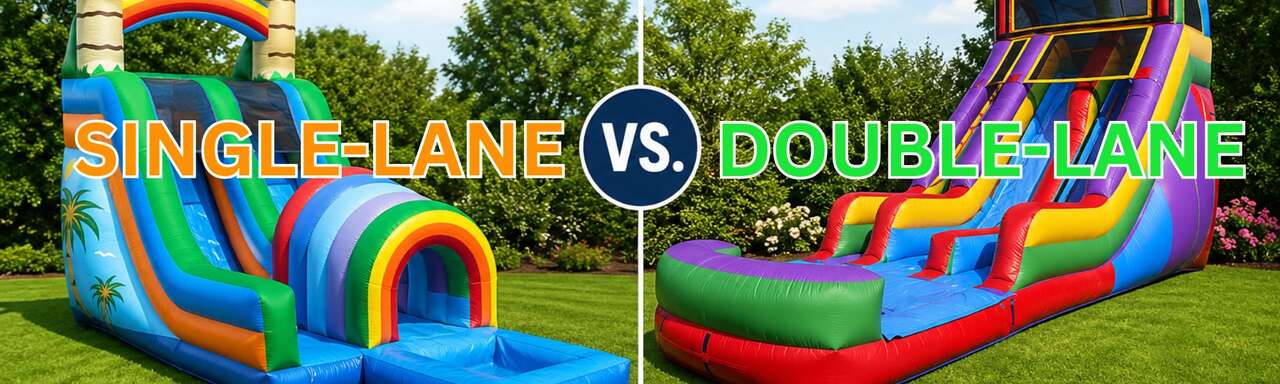
Single-Lane vs. Double-Lane Water Slides: Which Is Right for Your Party?
You've got a party date circled on the calendar, a yard full of excited kids in your head, and one big question: which water slide keeps everyone happy without turning your backyard into a bottleneck?
Single-lane slides look simpler and cost less. Double-lane slides promise racing fun and faster lines. But the wrong choice means bored kids waiting in line or a slide that overwhelms your younger guests.
This guide breaks down exactly when each type works best—covering space, guest count, age range, and the real throughput numbers that determine whether your party flows smoothly or stalls out.
On This Page
Which Type of Party Are You Planning?
Before you compare slides, figure out which scenario matches yours. Your guest count, ages, and space dictate almost everything.
15-25 Kids, Ages 4-10
You're hosting at home. Most kids are in the same age range. You want simple setup, room for other activities, and a price that doesn't blow your budget.
Likely best fit: Single-lane slide unless you have competitive older kids who'll demand racing.
40+ Kids, Mixed Ages
School carnival, church picnic, or neighborhood block party. Kids span from toddlers to tweens. Lines form fast. You need throughput and entertainment value.
Likely best fit: Double-lane slide—the racing keeps older kids engaged while doubling your rider capacity.
30-50 Kids, Big Yard
You're celebrating summer, a milestone, or just going big. You have the space. You want the "wow" factor. Budget isn't the primary concern—entertainment value is.
Likely best fit: Double-lane slide—it becomes the centerpiece and handles high traffic without frustration.
The Real Differences That Matter
Forget marketing hype. Here's what actually changes between single and double lanes.
Single-Lane Water Slides
- Typical size: 12-13 feet wide, 22-28 feet long, 10-15 feet tall
- Capacity: One rider at a time, 8-12 kids per hour depending on slide time and line management
- Setup space: Needs minimum 12×25 feet footprint plus 4-6 feet clearance on all sides
- Best for: Younger kids (3-8), smaller parties (under 20 guests), tighter budgets
- Cost: Typically $200-350 for a 4-6 hour rental
Double-Lane Water Slides
- Typical size: 15-16 feet wide, 24-30 feet long, 12-16 feet tall
- Capacity: Two riders at once, 16-24 kids per hour—effectively doubles throughput
- Setup space: Needs minimum 15×30 feet footprint plus same 4-6 feet clearance around
- Best for: Mixed ages, competitive kids, parties over 25 guests, racing entertainment
- Cost: Typically $300-450 for a 4-6 hour rental
Pro tip: The width difference is usually only 3-4 feet, but that matters if you're working with side gates, narrow yards, or tight clearances. Measure your space before assuming a double lane fits.
Throughput: How Many Kids Per Hour?
This is where parties live or die. Throughput is how many kids can slide per hour without standing in a frustrating line.
Average slide time (climb + slide + splash + exit): 90-120 seconds per kid. That's the bottleneck.
Single Lane
Realistic throughput: 25-30 rides per hour in ideal conditions
If you have 20 kids and each wants 3-4 turns, that's 60-80 total rides needed. On a single lane, that's roughly 2.5-3 hours of continuous sliding to give everyone their turns.
Works great when: Kids rotate to other activities (bounce house, lawn games, eating), keeping the slide line moving without pressure.
Double Lane
Realistic throughput: 50-60 rides per hour in ideal conditions
Same scenario—20 kids, 3-4 turns each—cuts your total slide time nearly in half. That means shorter waits, less boredom, and more energy for the rest of the party.
Game-changer when: The slide IS the main attraction or you have 30+ kids who all want multiple turns.
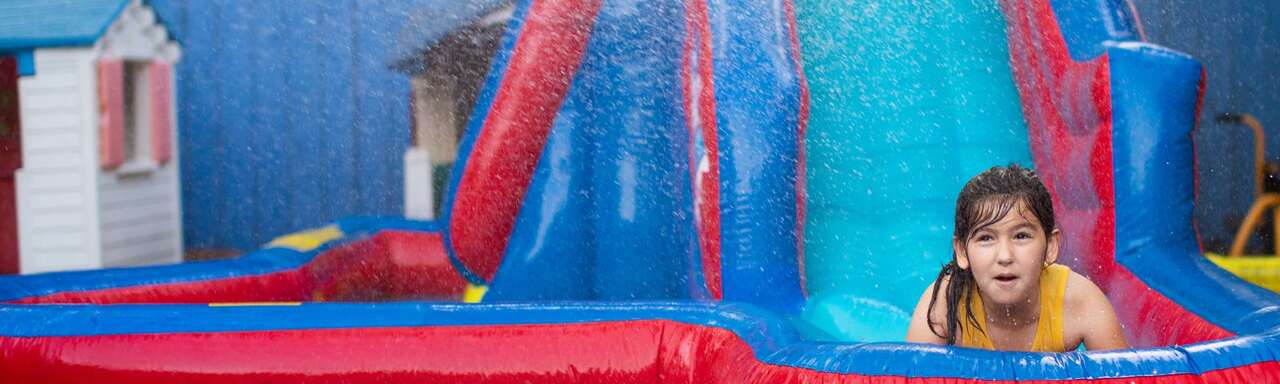
Caution: Throughput math assumes constant flow. In reality, kids stop to argue about who goes next, parents enforce sunscreen reapplication, and someone always has to pee right when it's their turn. Double those times if you're not actively managing the line.
Space Requirements You Can't Ignore
The slide itself is only part of the footprint. You need clearance on all sides for safety, setup stakes, and blower placement.
Single Lane
- Slide footprint: 12×25 feet
- Total space needed: 20×35 feet minimum
- Gate clearance: 4 feet wide minimum
- Overhead clearance: 18 feet (watch for tree branches, power lines)
Double Lane
- Slide footprint: 15×30 feet
- Total space needed: 23×40 feet minimum
- Gate clearance: 5 feet wide minimum
- Overhead clearance: 20 feet (taller slides = more clearance)
Pro tip: Walk your yard with a tape measure before booking. Stand where the slide will go and look up—power lines, low tree branches, and roof overhangs are the #1 reason slides can't be set up as planned. If you're even slightly unsure, send photos to your rental company first.
What Eats Up Extra Space
- Blower placement: Needs 3-4 feet of clearance, can't be near water or inside
- Stake-down zone: 2-3 feet on each side for ground anchors (or sandbag space if on concrete)
- Splash pool runoff: Water drains forward, so don't put the slide exit near gardens, basement window wells, or garage doors
- Kid congregation zone: They cluster at the bottom waiting for their turn—factor in 6-8 feet of standing room
Age Range and the Racing Factor
Single vs. double isn't just about capacity. It's about how kids interact with the slide.
Single Lane Sweet Spots
- Preschoolers (3-5 years): They focus on the slide itself, not competition. A single lane feels less overwhelming and parents can supervise one kid at a time more easily.
- Timid kids: If your child is nervous about heights or water, a single lane lets them take their time without the pressure of someone racing next to them.
- Small friend groups: 8-12 kids who know each other well don't need racing to stay entertained—they'll create their own games.
Double Lane Sweet Spots
- School-age kids (6-12 years): Racing becomes the entertainment. They'll organize tournaments, keep score, and replay races over and over.
- Mixed ages: Older kids get the competition, younger kids can still slide solo if they want—the double lane accommodates both styles.
- High-energy groups: Competitive kids, sports teams, or siblings who thrive on challenges will get way more value from a racing setup.
Caution: Double lanes can intimidate very young kids (under 5). The size, height, and racing element may overwhelm them. If your party is mostly preschoolers, err toward a single lane with a gentler slope.
Cost Breakdown: Is Double Worth It?
Double-lane slides typically cost $50-150 more than single lanes. Whether that's worth it depends on your guest count and party goals.
↑ What Pushes Cost Up
- Larger footprint = more materials and setup labor
- Dual-lane construction requires more stitching and reinforcement
- Higher demand during peak season (May-August)
- Premium models with tropical themes or LED lighting
↓ What Keeps Cost Down
- Booking mid-week or off-peak weekends (September-April)
- Standard models without themed graphics or extras
- Shorter rental windows (4 hours vs. all-day)
- Bundling with other inflatables (combos often get discounts)
When the Extra Cost Pays Off
Run this simple calculation: divide your guest count by 12.
- Under 20 kids: Single lane handles it comfortably. Save the money.
- 20-30 kids: Toss-up. Consider age range and whether you have other activities to rotate through.
- Over 30 kids: Double lane is worth every penny. The throughput and entertainment value justify the cost.
Pro tip: If you're torn, ask your rental company if they offer a last-minute upgrade option. Some companies let you pay the difference on delivery day if you realize a single lane won't cut it.
Your Decision Map
Use this simple framework to lock in your choice. Check the boxes that match your situation, then follow the pattern.
- ☐ Measure your yard with tape measure
- ☐ Count confirmed RSVPs (not maybes)
- ☐ Check overhead clearances (power lines, trees)
- ☐ Note age range of attending kids
- ☐ Identify other activities planned
- ☐ Test water pressure before kids arrive
- ☐ Assign an adult to monitor the slide area
- ☐ Enforce one-at-a-time rule (single) or simultaneous starts (double)
- ☐ Keep towels and a first-aid kit nearby
- ☐ Rotate kids to other activities every 20-30 minutes
- ☐ Turn off water 15 minutes before pickup
- ☐ Let kids play until blower shuts off (they love the deflation phase)
- ☐ Note what worked/didn't for next year
- ☐ Leave honest review for rental company
Red Flags That Mean You Chose Wrong
Watch for these warning signs during your party. If you see three or more, you probably needed the other slide type.
🚩 Kids standing in line for 10+ minutes between turns
You needed a double lane or another activity to split the crowd.
🚩 Older kids arguing about who's faster with no way to prove it
Racing element would've solved this instantly.
🚩 Younger kids overwhelmed by the slide's size or speed
You needed a smaller, gentler single-lane slide.
🚩 Parents hovering because two kids keep trying to race on a single lane
Safety risk. Double lane would've channeled that energy safely.
🚩 Slide sits empty most of the time because kids lost interest
Racing would've kept engagement higher, or you overpaid for capacity you didn't need.
🚩 Setup crew struggled with tight space or had to reposition
You needed a single lane, or you didn't measure properly.
Common Questions Answered
Which water slide is better for a birthday party? +
Single-lane slides work best for younger kids (3-8) and smaller parties under 20 kids. They're less overwhelming, easier to supervise, and cost less. Double-lane slides are better for mixed ages, competitive kids, or parties over 25 guests where you need to move lines faster and add the entertainment value of racing.
Consider your space, guest count, and whether your kids thrive on competition. If most attendees are preschoolers, single lane. If you have school-age kids who love challenges, double lane pays off.
Is a double-lane slide worth the extra cost? +
Yes, if you have more than 25 kids, mixed age groups, or want racing entertainment. The extra cost (typically $50-100 more) pays for itself in shorter wait times and built-in entertainment through racing. Kids organize their own tournaments and stay engaged longer.
Not worth it if your party is under 20 kids, mostly younger children, or you have several other activities that naturally rotate the crowd. In those cases, save the money and put it toward another rental or party element.
How do I choose the right water slide for my event? +
Start by counting confirmed guests and noting their age range. Then measure your yard—you need 20×35 feet minimum for single lanes, 23×40 feet for double lanes, including clearance. Check overhead for power lines and tree branches.
If you have under 20 kids or mostly younger children, go single lane. If you have 25+ kids, mixed ages, or competitive personalities, go double lane. When in doubt, send photos of your space to your rental company and ask for their recommendation based on your guest list.
Do double-lane slides take up a lot more space? +
Double-lane slides are typically 3-4 feet wider than single lanes but roughly the same length. You'll need about 15 feet width vs 12 feet for a single lane, plus the same clearance around all sides (4-6 feet). So the total footprint difference is about 3 feet wider and similar length.
The width difference matters most if you have narrow side gates (need 5 feet clearance vs 4 feet) or tight yard configurations. Always measure before assuming it fits—that extra 3-4 feet can be the difference between a smooth setup and a last-minute problem.
Can younger kids use double-lane slides safely? +
Yes, but supervision is key. Younger kids (under 6) may feel overwhelmed by the size, height, or racing element. They can slide solo on one lane while older kids race on both, but you need an adult monitoring to prevent younger kids from being pressured to race before they're ready.
If your party is mostly preschoolers (3-5 years old), a single lane with a gentler slide angle is usually a better fit. They get the full experience without intimidation, and you don't pay extra for racing features they won't use.
What if my yard is on a slope? +
Most rental companies can handle a slight grade (2-3 degrees), but steep slopes create safety issues and stability problems. The slide needs to be on relatively level ground—the slope can't run across the slide width or the lanes won't drain evenly.
Take photos of your yard from multiple angles and send them to your rental company before booking. They'll tell you if your slope is manageable or if you need to choose a different location. Never let a company set up on an unsafe grade just because you already paid.
Can adults use water slides? +
Most water slides have weight limits between 200-300 pounds depending on the model. Many adults can use them safely, but check the specific weight limit with your rental company. Commercial-grade slides handle adult weight better than budget models.
If you want adults to participate, mention that when booking so they can recommend a slide rated for higher weight. And set ground rules—adults go one at a time, no horseplay, and always feet-first. The slides are designed primarily for kids, so adult use is at your own risk.
Ready to Book Your Water Slide?
Now that you know which slide fits your party, check availability for your date. We'll confirm your space works, answer any final questions, and lock in your rental—no pressure, no surprises.
Browse our full selection of single-lane and double-lane water slides, see real photos, and compare options side-by-side.
Questions about setup, space, or which slide works best? Contact your local Afford-a-Bounce team—we'll walk you through it.