
Water Slide Setup Requirements: Space, Drainage & Power
You found the perfect water slide online. The kids are excited. The date is set. Then you get to the checkout page and see: "customer must provide adequate space, power source, and water access."
Wait—what does that actually mean? How much space is "adequate"? Will your backyard work? Do you need a special outlet?
This guide walks through every physical requirement for water slide setup—space dimensions, power needs, water sources, drainage considerations, and surface prep—so you know exactly what to check before booking.
What You'll Learn
Which Type of Party Planner Are You?
Backyard Birthday Parent
You're planning a party at home and need to know if your yard can handle a water slide. Check space, drainage, and outlet locations first.
Focus on: Space requirements, surface prep, and water drainage solutions
Community Event Organizer
You're coordinating a church picnic, school carnival, or company party at a park or facility. Power access and water hookups are your main concerns.
Focus on: Generator alternatives, hose length, and venue coordination
First-Time Renter
You've never rented an inflatable before and don't know what questions to ask. This guide covers everything from scratch.
Focus on: The complete checklist and FAQ section at the end. You can also visit our water slide blogs for more helpful tips.
Space Requirements: How Much Room You Really Need
The listed dimensions you see online—like "18' L x 10' W x 12' H"—are the inflated footprint only. The actual setup space is always bigger.
Add Clearance on All Sides
You need 3-5 feet of clearance around the entire perimeter for:
- Stakes or sandbags that anchor the unit
- Blower placement (can't block airflow)
- Safe entry/exit zones
- Adult supervision sight lines
👉 Real-World Example: An 18x10 water slide needs a 25x17 setup area minimum. If your yard is 30 feet wide, you're good. If it's 22 feet, the slide won't fit.
Overhead Clearance Matters Too
Check for low-hanging branches, power lines, roof eaves, or patio covers. Most slides are 10-14 feet tall when inflated.
If a tree branch hangs at 9 feet, it's too low. Wind can push the inflated slide into obstacles, causing punctures or safety hazards.
Access Path Width
Delivery crews need to carry the rolled-up slide from the truck to your backyard. Most units weigh 150-250 pounds and measure 3-4 feet wide when rolled.
Check your side gate width. A 36-inch gate minimum works for most slides. If your only access is a 30-inch gate or through the house, call the rental company first—some units can't squeeze through.
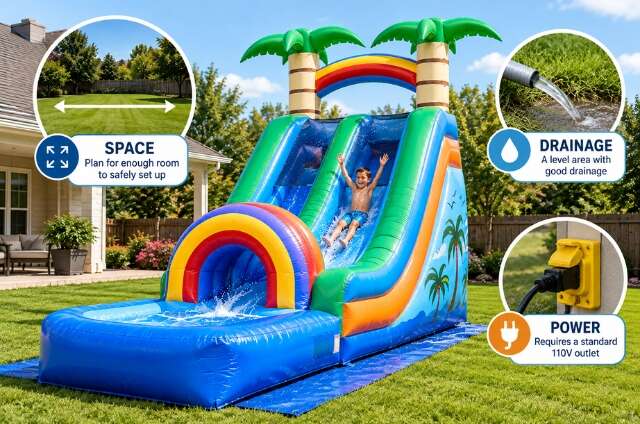
✓ Ideal Setup Space
- 5+ feet clearance on all sides
- Flat, level ground (less than 5° slope)
- 15+ feet overhead clearance
- 36"+ wide access gate
- No sharp rocks, roots, or debris
✗ Deal-Breaker Conditions
- Space smaller than slide + 6 feet
- Slope greater than 10 degrees
- Power lines within 10 feet overhead
- Access path under 30 inches
- Large rocks, stumps, or concrete edges
Power & Electricity: What Outlets Work
Inflatable water slides stay inflated using a continuous-duty air blower. That blower must stay plugged in and running the entire rental period. If power cuts out, the slide deflates in 5-10 minutes.
Standard 110V Outlet Required
You need a dedicated 15-20 amp household outlet within 75 feet of the setup location. Most blowers draw 7-12 amps.
"Dedicated" means the outlet should not be powering other high-draw devices during the event. Don't plug the blower into the same circuit running your pool pump, garage fridge, or window AC unit.
⚠️ Warning: GFCI outlets (the ones with "test" and "reset" buttons, common near water sources) sometimes trip under continuous load. Let the rental company know if your outdoor outlet is GFCI-protected—they may bring a non-GFCI adapter or test it during setup.
Extension Cords: Provided by the Rental Company
Professional rental companies provide commercial-grade 12-gauge extension cords rated for outdoor use. Do not use your own household extension cord—they're not rated for continuous 10+ amp loads and create fire hazards.
If the outlet is more than 75 feet away, you may need a generator. Some companies include generator rental in the package for park events; others charge extra.
Generator Option for Parks or Remote Locations
Planning a party at a park pavilion with no outlets? You'll need a generator. A 2000-watt portable generator can run one water slide blower for 6-8 hours on a tank of gas.
Ask the rental company if they provide generators. Some do. Some require you to rent separately. Either way, the generator should be placed at least 20 feet away from the slide to reduce noise and fumes near kids.
Quick Power Checklist
- Outlet within 75 feet? Measure from setup spot to nearest exterior outlet.
- Dedicated circuit? Avoid sharing with heavy appliances.
- GFCI protected? Mention it when booking.
- No outlet at all? Ask about generator rental or package.
Water Source & Pressure Requirements
Water slides need a continuous water supply during use. Not a bucket. Not a one-time fill. A garden hose connected to a spigot that runs the entire event.
Standard Garden Hose Connection
You need an outdoor water spigot (the threaded faucet where you attach a garden hose) within 50-100 feet of the setup area. Rental companies typically provide the hose, but confirm when booking.
If your spigot is farther than 100 feet, water pressure drops. The slide may not get enough flow to keep surfaces slick. Let the company know—they may bring a booster pump or longer hose.
How Much Water Does a Slide Actually Use?
Most residential water slides use 4-8 gallons per minute once the initial pool fill is done. The slide takes 15-30 minutes to fill the splash pool at the bottom, then the hose runs at a trickle to keep the slide surface wet.
For a typical 4-hour party, expect to use 150-250 gallons total. On most city water bills, that's about $1-2.
4-5 GPM continuous
≈ 120-180 gallons for 4 hours
5-7 GPM continuous
≈ 180-250 gallons for 4 hours
7-10 GPM continuous
≈ 250-350 gallons for 4 hours
Water Pressure Check
Low water pressure is the most common water-related issue. If your house has older plumbing or you're on a well system, test your spigot before the event.
Turn on the hose full blast and fill a 5-gallon bucket. If it takes more than 2 minutes, your pressure may be too low. Call the rental company—they can bring a pump or recommend a smaller slide that works with lower flow.
👉 Pro Tip: If you're hosting on a hot day (95°F+), the slide will use slightly more water to keep surfaces cool. Plan for the higher end of the usage range.
Drainage & Runoff: Where the Water Goes
Water slides create continuous runoff. Kids splash. Water flows down the slide. The pool at the bottom overflows. All that water has to go somewhere.
If the setup area has poor drainage, you'll end up with a muddy mess, standing water that attracts mosquitoes, or worse—water pooling near your home's foundation.
Grass Absorbs Some, But Not All
Most backyard setups happen on grass. Healthy turf can absorb 3-5 gallons per minute if the soil drains well. That's fine for smaller slides on a 4-hour rental.
But if your yard has heavy clay soil, compacted dirt, or it rained recently, the ground won't absorb water fast enough. You'll see puddles forming around the slide within 30 minutes.
Ideal Drainage Conditions
- Slight slope: A gentle 2-3 degree slope away from buildings helps water run off naturally
- Sandy or loamy soil: Drains faster than clay
- No standing water 24 hours after rain: If your yard holds puddles for days, it won't handle slide runoff
- Distance from foundation: Set up at least 10 feet from your house to avoid water seeping toward the foundation
🚨 Non-Negotiable: Never set up a water slide on a slope that drains toward your house, garage, or neighbor's property. Water will flow downhill and cause problems. Always position the slide so runoff drains toward the street, a storm drain, or an open area.
What If Drainage Is Poor?
If you know your yard doesn't drain well, you have three options:
1. Use a Dry-Use Water Slide
Some slides work wet or dry. You skip the water source entirely and use it like a regular bounce house with a slide exit. No drainage issues. See dry-use water slide options.
2. Create a Runoff Path
Dig a shallow trench or lay a plastic channel that directs water away from the slide area toward a storm drain, street gutter, or drainage ditch. Cover it with mulch or gravel to prevent mud.
3. Set Up on Concrete/Asphalt
Driveways and patios don't absorb water—they drain it via slope. Water runs to the street or yard edge. Just make sure the surface is smooth (see surface prep section below).
Surface Prep: What the Slide Can Sit On
Water slides can be set up on grass, concrete, asphalt, or packed dirt. Each surface has pros and cons.
Grass: The Most Common Setup
✅ Pros: Soft landing if kids fall. Easy to stake. Natural drainage if soil is healthy.
❌ Cons: Grass under the slide will yellow or die if left inflated for more than 8 hours. Wet grass becomes slippery. Roots, rocks, or uneven ground can create bumps.
Prep needed: Mow the grass short. Walk the area and remove sticks, rocks, pinecones, or toys. Fill in any low spots or gopher holes.
Concrete or Asphalt: Best for Drainage
✅ Pros: Excellent drainage. No stakes needed (sandbags or water weights used instead). Works great for driveways or patios.
❌ Cons: Harder surface means more supervision needed to prevent injuries. Can get hot in direct sun (water cools it down once the slide is running).
Prep needed: Sweep the area clean. Check for sharp edges, cracks, or exposed rebar. Rental companies often place a tarp under the slide for protection.
What NOT to Set Up On
🚩 Gravel or Mulch: Punctures the slide material. Sharp edges tear vinyl.
🚩 Steep Slopes: Slides must be level. Anything over 10° slope is unsafe and won't pass setup inspection.
🚩 Near Sprinkler Heads: Stakes can hit underground irrigation lines. Mark sprinkler locations before setup.
🚩 Over Tree Roots: Large surface roots create bumps and uneven sliding surfaces.
🚩 Sand or Loose Dirt: Can't anchor properly. Slides shift during use.
🚩 Near Fire Pits or Grills: Keep inflatables 20+ feet from open flames or hot surfaces.
Pre-Rental Checklist: Confirm Before You Book
Use this checklist before you finalize your reservation. It takes 10 minutes and prevents day-of surprises.
Space & Access
- ☐ Measured setup area (slide dimensions + 6 feet on all sides)
- ☐ Checked overhead clearance (15+ feet with no branches/wires)
- ☐ Measured gate width (36" minimum for most slides)
- ☐ Confirmed ground is level (less than 10° slope)
Power
- ☐ Located outdoor outlet within 75 feet of setup
- ☐ Tested outlet (plugged in a high-draw device to confirm it works)
- ☐ Noted if outlet is GFCI-protected
- ☐ Arranged generator rental if no outlet available
Water
- ☐ Confirmed spigot within 100 feet of setup
- ☐ Tested water pressure (5-gallon bucket fills in under 2 minutes)
- ☐ Asked rental company if hose is provided
Drainage & Surface
- ☐ Checked that runoff slopes away from buildings
- ☐ Walked setup area and removed rocks, sticks, debris
- ☐ Marked sprinkler head locations (if any)
- ☐ Confirmed surface is grass, concrete, or asphalt (not gravel/mulch)
Safety
- ☐ Setup area is 20+ feet from grills, fire pits, or flames
- ☐ No sharp edges, exposed rebar, or concrete corners nearby
- ☐ Adult supervision plan in place (someone watching at all times)
Common Water Slide Setup Questions
Can I set up a water slide indoors?+
No. Water slides create continuous water runoff that will flood indoor floors. They also require outdoor ventilation for the blower. Indoor inflatables are bounce houses or dry slides only—never water slides.
What happens if it rains on the day of my rental?+
Light rain is fine—water slides are already wet. Heavy rain, lightning, or winds over 15 mph are unsafe. Most rental companies allow free rescheduling if severe weather is forecasted. Check the cancellation policy when booking.
Do rental companies provide stakes, sandbags, and hoses?+
Yes. Professional companies provide all anchoring equipment (stakes for grass, sandbags for concrete), extension cords, and water hoses. You only provide the water source, power outlet, and setup space.
How long does setup take?+
Professional crews typically take 30-45 minutes to unload, inflate, stake, and test a water slide. Add another 20-30 minutes for the slide to fill with water. Plan for the delivery window to be 1-2 hours before your party start time.
Can I move the slide once it's inflated?+
No. Once inflated and staked, the slide stays in place. Moving it requires deflating, repositioning, and re-inflating—which takes another 45+ minutes and risks damaging the unit. Choose your setup location carefully before the crew arrives.
What if my yard is too small but I still want a water slide?+
Ask about compact or vertical water slides. Some models are 12-15 feet long instead of 20-25 feet and work in smaller yards. You can also host at a local park—many parks allow inflatable rentals with a permit.
Will the slide damage my grass?+
The grass under the slide will yellow from lack of sunlight if left inflated more than 8 hours. For a standard 4-6 hour party rental, the grass usually recovers within a week with normal watering. Stakes leave small holes that fill in naturally.
Do I need to supervise the slide the entire time?+
Yes. An adult must watch the slide at all times during use. Rental companies deliver and set up, but supervision during the event is your responsibility. Enforce one-at-a-time sliding, no climbing on the outside, and age/size restrictions.
Can adults use water slides?+
It depends on the slide's weight limit. Most residential water slides are rated for kids up to 150-200 pounds per rider. Some larger slides accommodate adults. Check the specs before booking if you want grown-ups sliding.
Ready to Book Your Water Slide?
Now you know exactly what your yard needs: space, power, water, and drainage. No surprises. No day-of scrambling.
Browse our clean, safe, and affordable water slides—delivered on time, set up right, and ready to make your party the one everyone remembers.